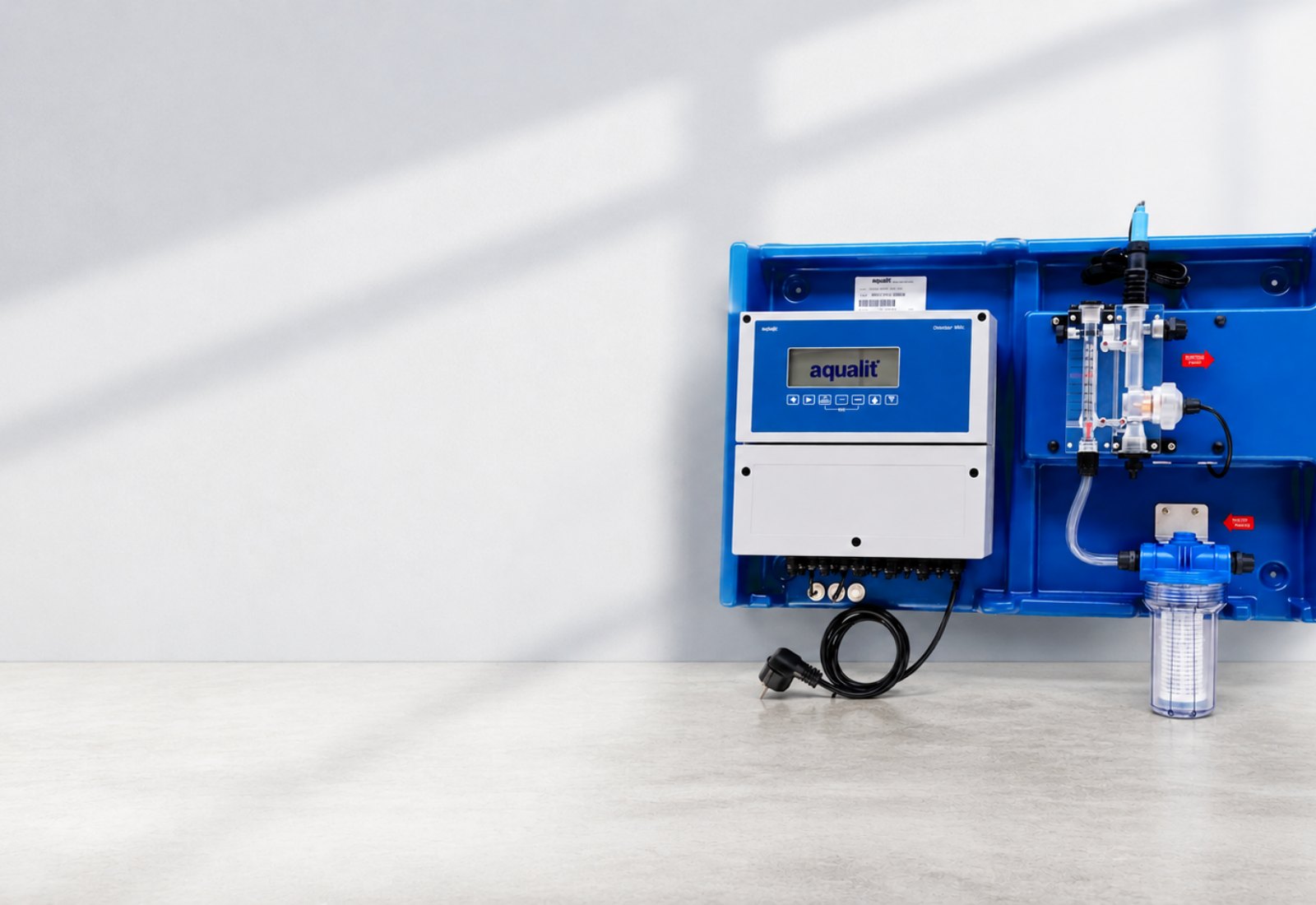
Yes — a traditional chlorine pool can be automated without converting to salt. True chemistry automation uses sensors to measure the water and a controller to decide when correction is needed, then doses liquid chlorine and acid accordingly. That is different from a tablet feeder, which delivers chlorine on a mechanical setting regardless of demand, and different from a salt system, which generates chlorine but does not by itself decide how much your water needs.
There are two viable paths, and both can end up with automated pH control. Which one suits you is a question of convenience, budget and how you feel about handling chemicals — not a question of which is objectively better.
Path A · Traditional chlorine
Automating the pool you already have
You keep a conventional chlorine pool and add automation in stages. Each stage is a real improvement on its own, so you can stop wherever the value stops making sense for you.
Stage 1 — Existing tablet feeder: semi-automatic delivery, but it has no idea whether demand is high or low
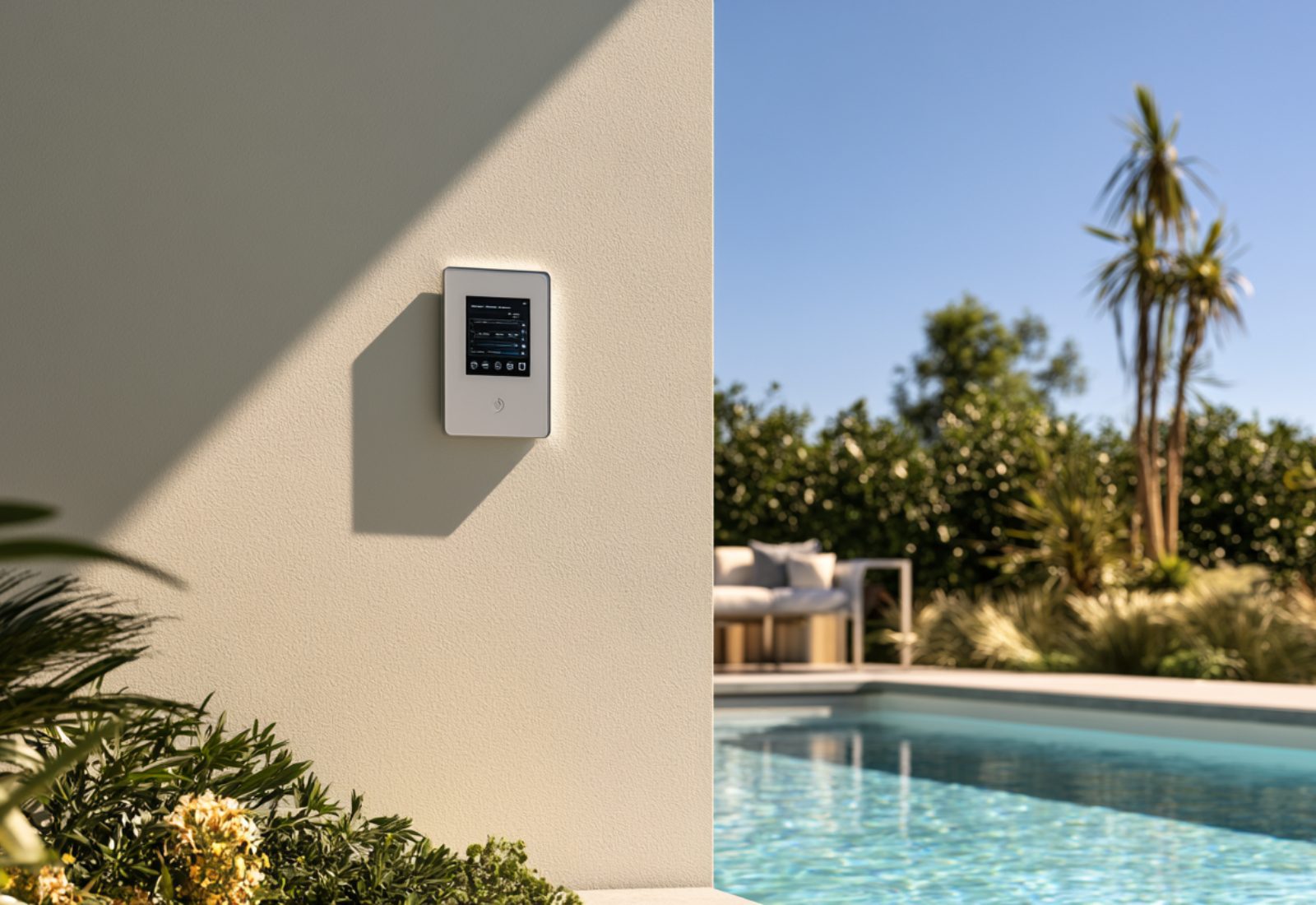
Stage 2 — Smart monitoring: pH, ORP (sanitizer activity) and temperature readings; a person still makes the adjustments
Stage 3 — Automated liquid chlorine: a tank and feed pump, with the controller deciding when sanitizer correction is required
Stage 4 — Automated chlorine and pH: adds a muriatic acid tank and dosing pump so both key corrections are handled
Important distinction: automatic chlorination is not the same as chemical automation. A feeder feeds. A salt cell generates. Only a sensor-and-controller system decides.
Path B · Salt chlorination
Generating chlorine instead of handling it
A saltwater pool is still a chlorine pool. Dissolved salt in the water passes through a cell that generates chlorine electrically, so you stop buying and loading tablets. It is a convenience decision more than a cost decision.
Less routine tablet handling
Automatic chlorine generation while the pump runs
Does not continuously add CYA the way trichlor tablets do
Pairs with automated pH dosing, same as the liquid chlorine path
We will also tell you the tradeoffs: higher initial equipment cost, the cell eventually needs replacing, cells scale, pH management is still required, and there are compatibility and corrosion considerations. See our full saltwater page.
Works with both paths
Automated pH is the piece people miss
Whether you sanitize with liquid chlorine or a salt cell, pH still drifts — and in salt pools it tends to rise. An acid dosing system with pH sensing handles that correction between service visits rather than letting it wander until someone notices.
pH probe and controller
Muriatic acid tank and dosing pump
Correction triggered by measurement, not by schedule
Available with traditional chlorine or salt chlorination
Comparison
Feeder vs salt cell vs sensor-driven dosing
Tablet feeder
Salt system
Sensor-driven dosing
What it does
Dissolves tablets at a set rate
Generates chlorine from dissolved salt
Measures water, then doses
Responds to actual demand
No
Only via output setting you choose
Yes — that is the point
Handles pH
No
No (and pH tends to rise)
Yes, with acid dosing added
Chemical handling for you
Loading tablets
Adding salt occasionally
Refilling tanks periodically
Adds CYA over time
Yes, with trichlor
No
No, with liquid chlorine
Ongoing consumables
Tablets
Salt; cell replacement eventually
Liquid chlorine and acid
None of these removes the need for water testing. Sensors drift and need verification — that is part of what our service visits are for.
Fit check
Who chemistry automation suits
Strong fit if
You travel or are away from the pool for stretches
Your pool has high or variable chlorine demand
You dislike storing and handling chemicals
Chemistry drifts noticeably between weekly service visits
You have a large pool where manual correction is a real chore
Probably not yet if
Your pool is small and demand is stable and predictable
You are comfortable testing and dosing and genuinely do not mind it
The equipment pad has no practical space for tanks
Budget is better spent on circulation or a failing heater first
You expect it to mean you never test water again — it does not
Questions
Water care FAQ
No. This is one of the most common misconceptions we hear. A traditional chlorine pool can be fully automated with sensors, a controller, a liquid chlorine tank and feed pump, and an acid tank and dosing pump for pH.
Salt is a different way of producing chlorine, not a prerequisite for automation.
ORP stands for oxidation-reduction potential. It measures the sanitizing power of your water rather than the concentration of chlorine directly. It is a very useful control signal for automation, because it reflects how effectively the water is actually sanitizing.
It is not a substitute for a chlorine test. Interpreting ORP correctly requires context — pH, cyanuric acid and temperature all affect it — which is part of why human oversight still matters.
When it is installed properly, yes. Correct tank placement, chemically appropriate tubing and fittings, proper injection points, flow interlocks so dosing cannot occur without circulation, and correct controller limits all matter.
This is not a DIY installation. Liquid chlorine and muriatic acid are hazardous chemicals and the equipment must be configured so a sensor fault cannot cause runaway dosing.
The system stops dosing that chemical, and your water starts drifting. Good installations include level monitoring or a schedule so refills happen before that point. Chemical replenishment is part of what we handle for service customers.
Yes. Sensors drift, probes need cleaning and calibration, and some parameters — total alkalinity, calcium hardness, cyanuric acid — are not measured by typical automation at all.
Automation reduces how often somebody has to correct the water. It does not remove the need to verify it.
AquaLit's recommendation
Start with measurement. Monitoring is the cheapest meaningful step, and it tells you whether you have a chemistry problem or a circulation problem before you spend anything on dosing equipment.
Choose between the two paths on how you feel about handling chemicals, not on which sounds more modern. Salt is a convenience decision. Sensor-driven dosing is a control decision. Both are legitimate; they solve different problems.
Add monitoring before dosing
Choose salt for convenience, dosing for control
Add pH correction whichever path you pick — it helps both
Only automate chemistry alongside a maintenance relationship that keeps probes honest
Call or text for a free pool assessment. We look at the pool, the equipment already on your pad and how you actually use the backyard — then tell you what is worth doing and what is not.
Tell us what you have and how you use the pool. We'll walk the equipment pad, ask what you ultimately want controlled, and give you an honest recommendation — including the upgrades we'd skip.