Fall special 15% off smart upgrades

Claim my 15% off

AquaLit

Pool Care & Automation

Automatic Chemical Dosing
Automated Water Care

Automatic Chemical Dosing

The part of pool automation that measures first and acts second — and the part that most needs installing properly.

Short answer

Automatic chemical dosing is a closed loop: probes measure the water continuously, a controller compares those readings against targets you set, and metering pumps inject liquid chlorine or muriatic acid only when correction is needed. It works on a traditional chlorine pool and on a salt pool alike, because pH control is useful either way.

It is the difference between a pool that is fed chemicals and a pool that is regulated.

How it works

Measure, decide, dose

1. Measure

An ORP probe reads oxidation-reduction potential — how effectively the water is sanitizing right now. A pH probe reads acidity. Both sit in a flow cell plumbed into the circulation loop so they see moving water rather than a stagnant sample.

2. Decide

The controller holds your target band and a set of limits: maximum dose length, minimum interval between doses, and a hard stop if readings look implausible. Those limits are what stop a drifting probe from becoming a chemistry incident.

3. Dose

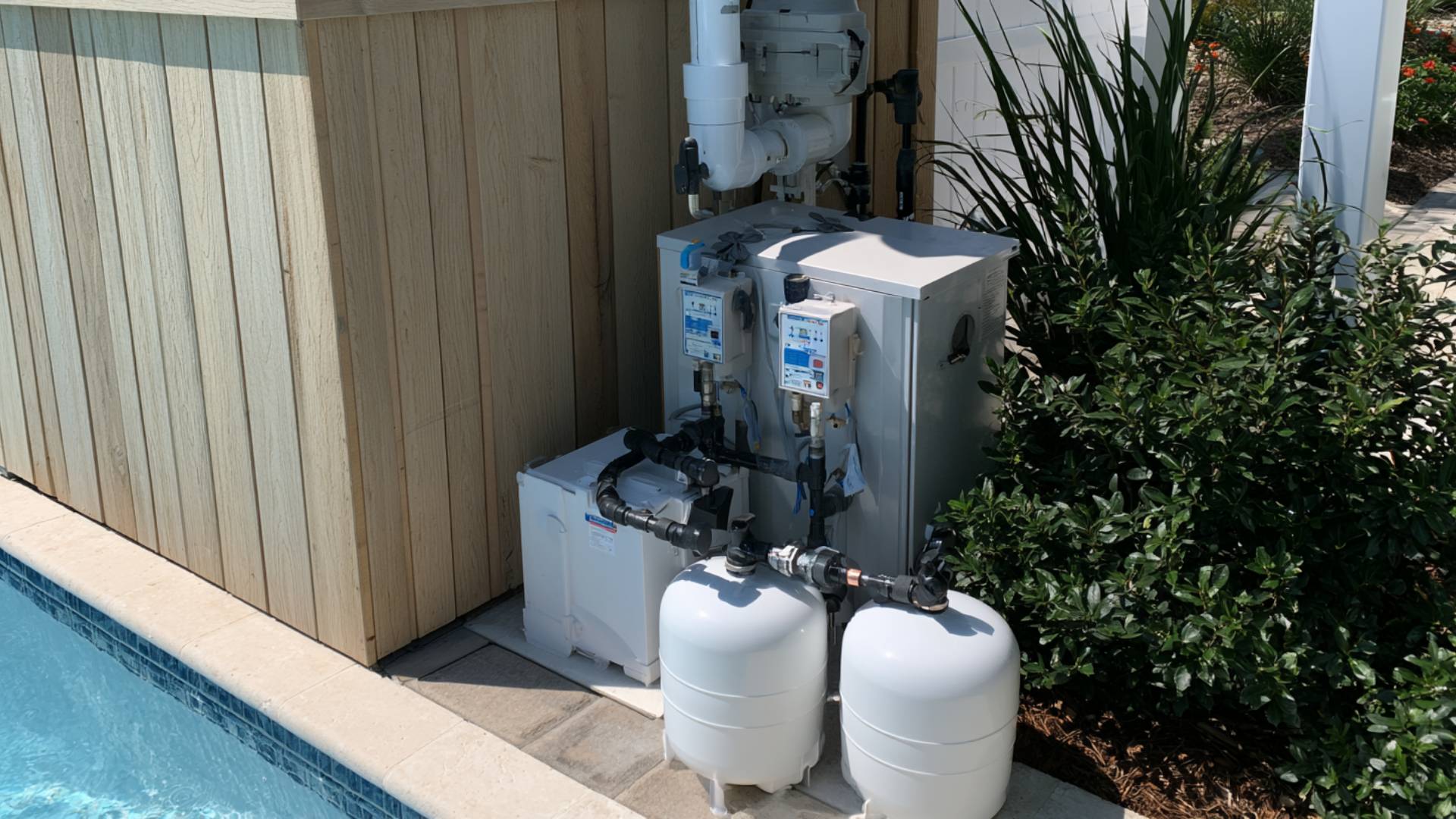
A peristaltic metering pump injects a measured volume into the return line, downstream of the heater, through an injection fitting sized for the chemical. Dosing is interlocked with flow — no circulation, no dosing.

4. Verify

Probes drift. They get coated, they age, and they read differently at different temperatures and stabiliser levels. Cleaning and calibration on a schedule is what keeps the loop honest, and it is why automated pools still get service visits.

What it does not measure

  • Total alkalinity
  • Calcium hardness
  • Cyanuric acid
  • Salt level, on a salt pool

All four still need testing by a person. They change slowly, which is exactly why they get forgotten on a pool that appears to be handling itself.
Fit check

Where dosing earns its cost

Strong fit

  • Pools with high or swinging chlorine demand through a Texas summer
  • Owners who travel or keep a second home
  • Salt pools where pH climbs and needs constant acid
  • Large-volume pools where manual correction is a real chore
  • Anyone who wants a chemistry record rather than a memory

Weak fit

  • Small, shaded, lightly used pools with stable readings
  • Equipment pads with no safe place for two chemical tanks
  • Owners unwilling to keep up probe cleaning and calibration
  • Budgets better spent on circulation, a failing heater or plumbing repair
Questions

Chemical dosing FAQ

ORP stands for oxidation-reduction potential. It measures sanitizing power rather than chlorine concentration, which makes it an excellent control signal but a poor substitute for a chlorine test.

Its reading is affected by pH, temperature and cyanuric acid. High CYA in particular suppresses ORP even when free chlorine looks fine on a test kit — one of several reasons a person still needs to look at the water.

No. It replaces most of the correcting. Verification, calibration and the parameters ORP cannot see all remain human work.

Accurate enough to control dosing well when they are clean, calibrated and interpreted in context. They drift over weeks and months rather than hours, which is manageable on a service schedule and problematic if nobody ever checks them.

Yes, with a pH probe and an acid metering pump. On salt pools this is particularly worthwhile, because chlorine generation and the aeration at the cell both push pH upward.

Ongoing costs are liquid chlorine and muriatic acid, periodic probe replacement, and the service time to calibrate. Against that, dosing to a measured target usually wastes less chemical than correcting a pool that has already drifted.

We will estimate for your pool during an assessment rather than quoting a number that assumes every pool is the same.

AquaLit's recommendation

Install dosing only alongside a maintenance relationship — your own or ours. An unverified sensor loop is not automation; it is an assumption with a Wi-Fi connection.

If nobody is going to clean and calibrate the probes, you will get better results and spend less money on a well-maintained salt system or a properly sized feeder.

  • Best paired with regular service so probes stay honest
  • Add pH control before sanitizer control if pH is your recurring problem
  • Insist on flow interlocks and dose limits — ask to see them configured
  • Keep chlorine and acid tanks physically separated at the pad

Let's talk about your pool

Call or text for a free pool assessment. We look at the pool, the equipment already on your pad and how you actually use the backyard — then tell you what is worth doing and what is not.

Free pool assessment

Tell us what you have and how you use the pool. We'll walk the equipment pad, ask what you ultimately want controlled, and give you an honest recommendation — including the upgrades we'd skip.

832-299-5570 (call or text) info@aqualitpools.com
Weston Lakes, TX — serving greater Houston
Mon–Fri 8am–6pm · Sat 8am–2pm

No obligation. We'll confirm a visit window by phone or text — usually within one business day.