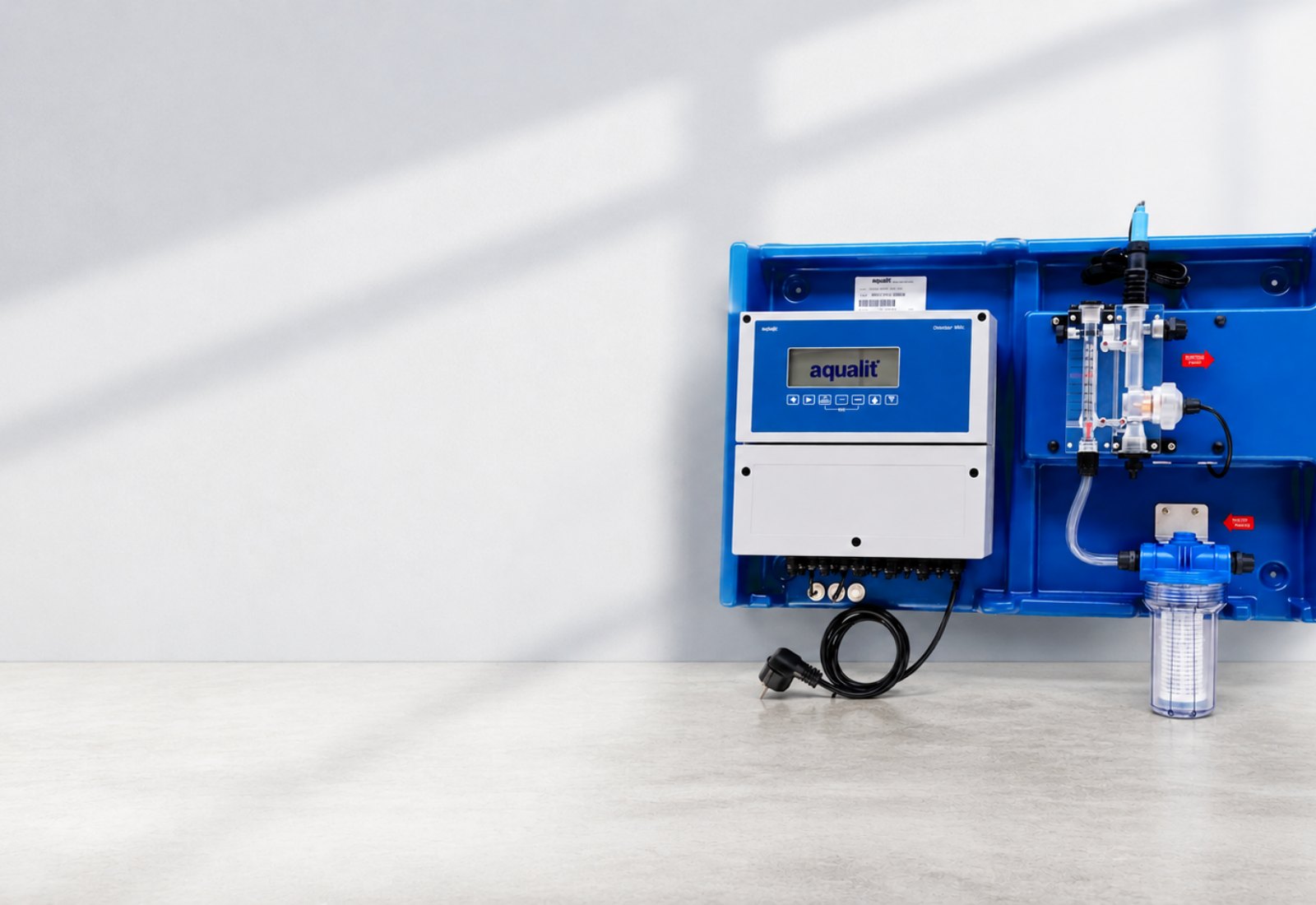
Yes, a traditional chlorine pool can be automated, and for many owners it is the better choice. Sensors measure the water, a controller decides when correction is needed, and metering pumps dose liquid chlorine and acid from tanks at the equipment pad. Nothing about the pool itself changes — no salt, no conversion, no new water chemistry to learn.
The important distinction: a tablet feeder feeds chlorine on a mechanical setting whether the pool needs it or not. Sensor-driven dosing responds to what the water is actually doing.
Stage 1
The tablet feeder you probably already have
An inline chlorinator such as a Pentair 320 dissolves trichlor tablets into the return line. It is semi-automatic delivery — genuinely useful, and the baseline most Houston-area pools start from.
Feeds chlorine continuously while the pump runs
Adjustable dial, but no idea what the water needs
Trichlor keeps adding cyanuric acid over time
Still requires you to buy, carry and load tablets
This is where automation starts, not where it ends. A feeder cannot tell the difference between a cool quiet week and a hot weekend with eight people in the pool.
Stage 2
Add measurement before you add dosing
Monitoring is the cheapest meaningful upgrade and the one we most often recommend first. Once you can see pH, sanitizer activity and temperature over time, you can tell whether you have a chemistry problem or a circulation problem.
pH probe
ORP probe for sanitizer activity
Water temperature
Readings logged and visible in your portal
At this stage a person still makes the adjustments. You have replaced guessing with knowing, which is worth doing on its own.
Stage 3
Automated liquid chlorine
A liquid chlorine tank and a metering pump, triggered by the controller when sanitizer activity falls below your target. This is the point at which the pool genuinely starts looking after itself between visits.
Chemically appropriate tank, tubing and injection point
Metering pump interlocked to circulation
Dosing driven by measurement, not by a timer
No further cyanuric acid accumulation
Stage 4
Chlorine and pH together
Adding a muriatic acid tank and a second metering pump means the two corrections that matter most are both handled. Sanitizer and pH stop drifting apart between service visits.
Second tank and metering pump for acid
pH held inside a band you set
Better sanitizer efficiency, because pH drives it
Fewer swing corrections and less chemical waste
Fit check
Who this suits — and who it does not
Automating your chlorine pool makes sense if
You are happy with the pool you have and do not want to convert
You travel, or the pool goes unwatched for stretches
Chemistry drifts noticeably between weekly service visits
Your cyanuric acid keeps climbing from trichlor tablets
You want measurement and a record, not just delivery
There is practical space at the pad for two tanks
Hold off if
Your pool is small with stable, predictable demand
You genuinely do not mind testing and dosing by hand
There is no safe, shaded location for chemical tanks
Circulation or a failing heater should take the budget first
You expect it to end water testing — sensors still need verifying
Comparison
Where each option actually lands
Tablet feeder
Salt system
Sensor-driven dosing
Responds to real demand
No
Only via a fixed output %
Yes
Handles pH
No
No — and pH tends to rise
Yes, with acid dosing
Adds cyanuric acid
Yes, with trichlor
No
No
Up-front cost
Lowest
Higher
Higher
Consumables
Tablets
Salt, then a cell
Liquid chlorine and acid
Chemical handling for you
Loading tablets
Occasional salt
Periodic tank refills
Gives you data
No
Limited
Yes
None of these ends water testing. Probes drift, and alkalinity, calcium hardness and CYA are not measured by typical automation at all.
Questions
Traditional chlorine automation FAQ
No. This is the single most common misconception we hear. Salt is a way of producing chlorine, not a prerequisite for automation. A conventional chlorine pool with sensors, a controller and metering pumps is arguably more automated than a basic salt pool, because it responds to measurement rather than running at a fixed output.
The 320 is a delivery device. It dissolves tablets at a rate you set and keeps doing that regardless of conditions. An automated dosing system is a control system: it measures sanitizer activity and pH, then doses only when the water asks for it.
One is a tap. The other is a thermostat.
A small metering pump — usually peristaltic — that injects a precise, controlled volume of liquid chlorine or acid into the return plumbing. It is interlocked with circulation so it cannot dose into still water.
Dosing for that chemical stops and the water begins to drift. Good installations include level monitoring or a scheduled refill so this is caught before it shows in the pool. Chemical replenishment is part of what we handle for service customers.
When installed correctly, yes. Correct tank siting, chemically compatible tubing and fittings, proper injection points, flow interlocks and sane controller limits all matter — as does keeping chlorine and acid physically separated.
This is not a DIY installation. Both chemicals are hazardous, and the system must be built so a single sensor fault cannot cause runaway dosing.
AquaLit's recommendation
For most Houston-area pools we recommend starting at Stage 2. Measurement is inexpensive, tells you whether you actually have a chemistry problem, and makes every later decision better informed.
Move to Stage 3 and 4 when the pool is genuinely unattended for stretches, when demand swings hard through summer, or when you simply want the chemical handling out of your life. If your only goal is convenience and you do not care about the data, salt chlorination may suit you better — we will say so.
Start with monitoring, not dosing
Add liquid chlorine dosing when demand is variable or you travel
Add acid dosing at the same time if pH is your recurring problem
We will not sell you Stage 4 for a pool that needs Stage 1 maintained properly
Call or text for a free pool assessment. We look at the pool, the equipment already on your pad and how you actually use the backyard — then tell you what is worth doing and what is not.
Tell us what you have and how you use the pool. We'll walk the equipment pad, ask what you ultimately want controlled, and give you an honest recommendation — including the upgrades we'd skip.